

- PID
- 3449988
BowjoA
- Certification
-
- Award
-
- Shipping
-
- Lead Time7 ~ 45days
- Modes of Transport EXW
- Products Shipped From Busan,Incheon,Seoul
- Payment
-
140+ Global Payments, trusted and secure payment provided by PayVerse.
Learn More
- Quantity
- MOQ : 100 Pieces
Detailed Description
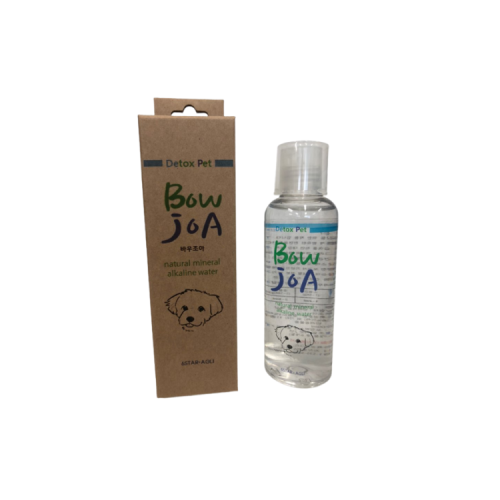
This product is convenient to use by diluting it in drinking water, and it is safe for dogs to eat as it is harmoniously composed of natural complex minerals.
According to the principle of effect, by increasing the activity of indigenous beneficial bacteria present in the large intestine among the digestive organs, the digestibility and absorption rate of the feed is increased, and the smell of feces is significantly reduced, thereby improving the living environment with dogs.
The health of the colon is directly linked to the strengthening of immunity, and it helps prevent infectious diseases and immunity to stress so that a healthy and happy dog can continue to lead a healthy life.
- Dog deodorant drink
- Good for Dog Health
- Replenishes Minerals
- Proper body balance support
- Maintain Hydration, For Mild Fluid Loss
- Makes 6.8 oz
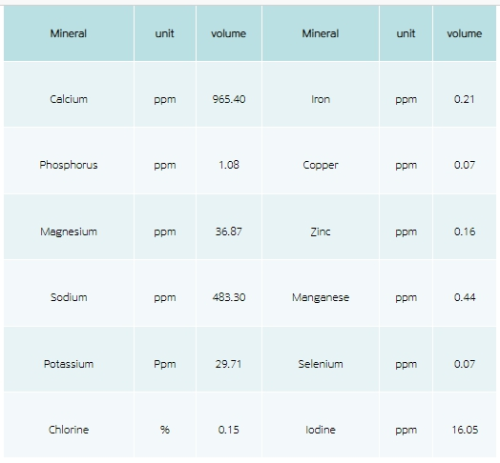
- Ingredient content (Table 1)
- References : YOUR DOG’S NUTRITIONAL NEEDS A Science-Based Guide For Pet Owners
Table 1
|
Mineral |
unit |
volume |
Mineral |
unit |
volume |
|
Calcium |
ppm |
965.40 |
Iron |
ppm |
0.21 |
|
Phosphorus |
ppm |
1.08 |
Copper |
ppm |
0.07 |
|
Magnesium |
ppm |
36.87 |
Zinc |
ppm |
0.16 |
|
Sodium |
ppm |
483.30 |
Manganese |
ppm |
0.44 |
|
Potassium |
Ppm |
29.71 |
Selenium |
ppm |
0.07 |
|
Chlorine |
% |
0.15 |
Iodine |
ppm |
16.05 |
YOUR DOG’S NUTRITIONAL NEEDS A Science-Based Guide For Pet Owners
COMMITTEE ON NUTRIENT REQUIREMENTS OF DOGS AND CATS
DONALD C. BEITZ, Chair, Iowa State University
JOHN E. BAUER, Texas A&M University
KEITH C. BEHNKE, Kansas State University
DAVID A. DZANIS, Dzanis Consulting & Collaborations
GEORGE C. FAHEY, University Of Illinois
RICHARD C. HILL, University Of Florida
FRANCIS A. KALLFELZ, Cornell University
ELLEN KIENZLE, Zentrum Für Lebensmittel Und Tierernährung, Oberschleissheim, Germany
JAMES G. MORRIS, University Of California, Davis
QUINTON R. ROGERS, University Of California, Davis
Support for this pamphlet was provided by the President’s Circle Communications Initiative of the
National Academies. The pamphlet was written by Dale Feuer based on a report by the Committee on
Nutrient Requirements of Dogs and Cats. Illustration and design by Van Nguyen.
Copies of Nutrient Requirements of Dogs and Cats are available from the National Academies Press,
500 Fifth Street, N.W., Washington, DC 20001; 800-624-6242 or 202-334-3313 (in the Washington area);
http://www.nap.edu.
Copyright 2006 by the National Academy of Sciences. All rights reserved.
INTRODUCTION
How much should I feed my dog? Does the food I’m providing meet my dog’s nutritional needs? As our knowledge of the relationship between diet and health continues to advance and as the range of foods available for dogs continues to expand, it’s more important than ever to base feeding choices on good information.
