- PID
- 3104402
Concrete Tiecell Block Column Breakwater Quaywall Shore Protection
- Certification
-
- Award
-
- Shipping
-
- Type of Freight MT
- Modes of Transport FOB
- Payment
-
140+ Global Payments, trusted and secure payment provided by PayVerse.
Learn More
- Quantity
- MOQ : 10 ea
Detailed Description
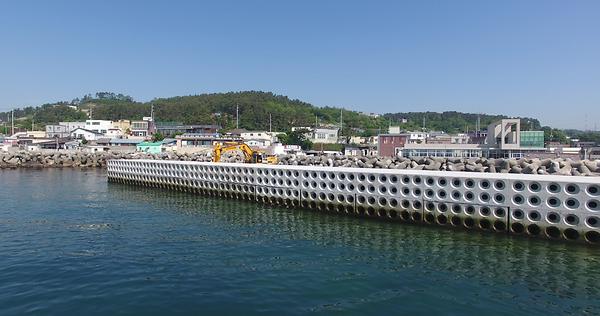
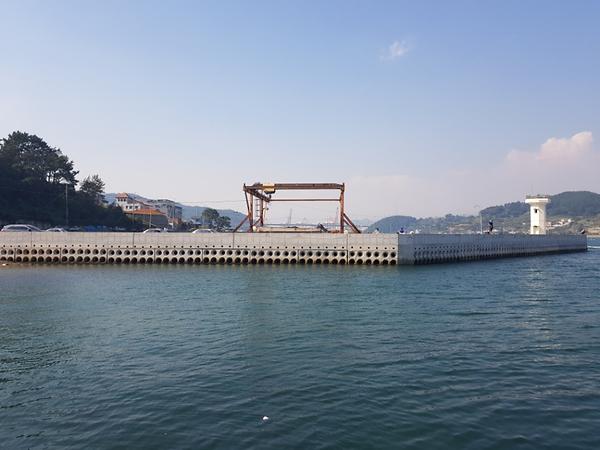
Tiecell Blocks
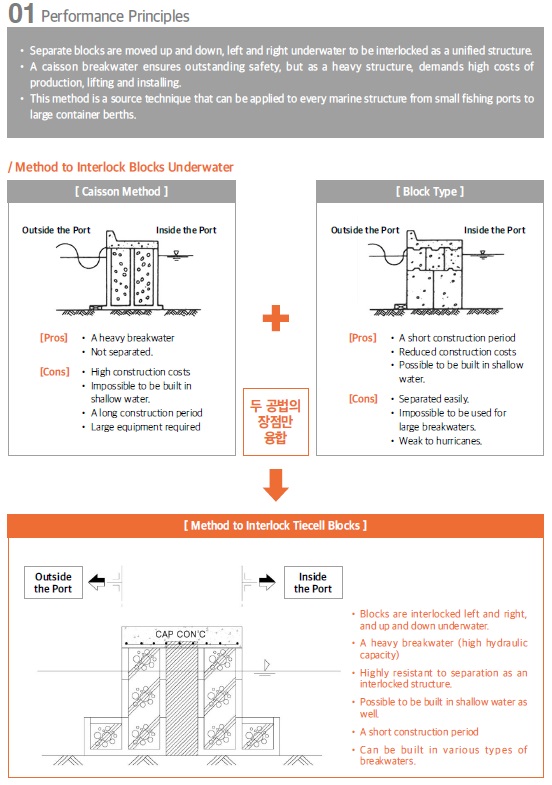
01 Performance Principles
• Separate blocks are moved up and down, left and right underwater to be interlocked as a unified structure.
• A caisson breakwater ensures outstanding safety, but as a heavy structure, demands high costs of production, lifting and installing.
• This method is a source technique that can be applied to every marine structure from small fishing ports to large container berths.
02 Performance Improvement
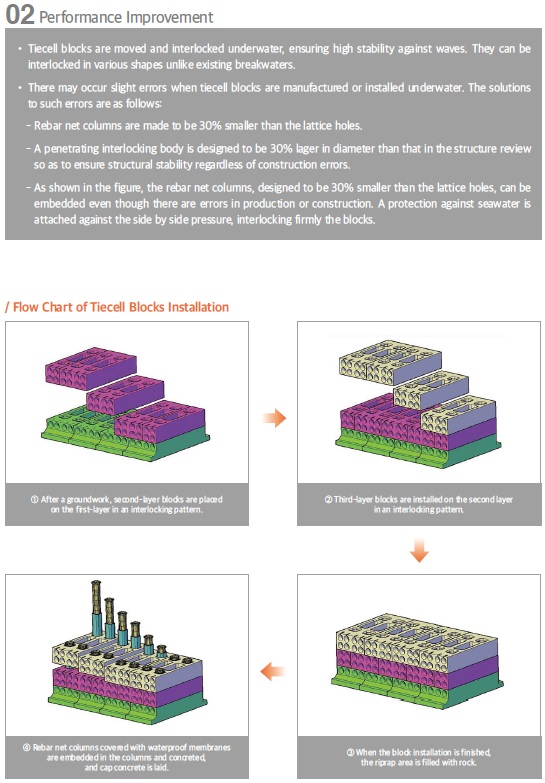
• Tiecell blocks are moved and interlocked underwater, ensuring high stability against waves. They can be interlocked in various shapes unlike existing breakwaters.
• There may occur slight errors when tiecell blocks are manufactured or installed underwater. The solutions to such errors are as follows:
- Rebar net columns are made to be 30% smaller than the lattice holes.
- A penetrating interlocking body is designed to be 30% lager in diameter than that in the structure review so as to ensure structural stability regardless of construction errors.
- As shown in the figure, the rebar net columns, designed to be 30% smaller than the lattice holes, can be embedded even though there are errors in production or construction. A protection against seawater is attached against the side by side pressure, interlocking firmly the blocks.
/ Flow Chart of Tiecell Blocks Installation
① After a groundwork, second-layer blocks are placed on the first-layer in an interlocking pattern.
② Third-layer blocks are installed on the second layer in an interlocking pattern.
③ When the block installation is finished, the riprap area is filled with rock.
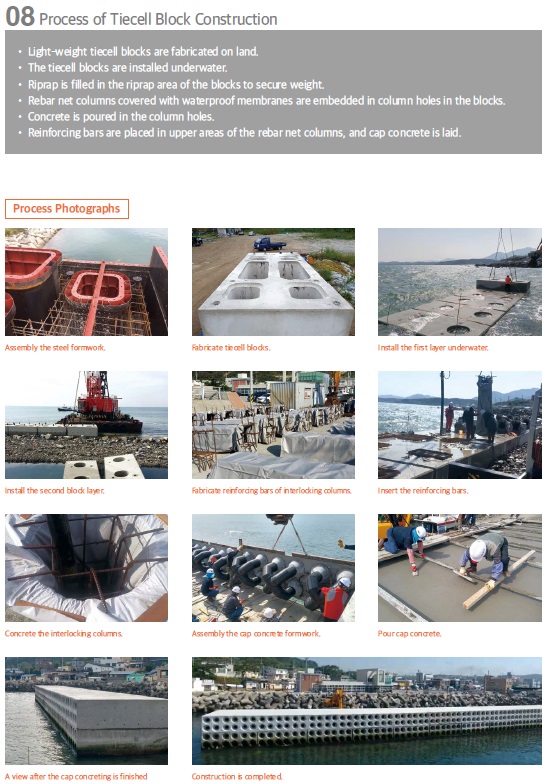
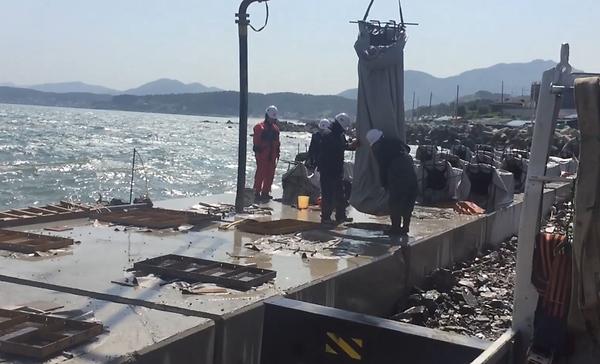
④ Rebar net columns covered with waterproof membranes are embedded in the columns and concreted, and cap concrete is laid.
03 Economic Efficiency
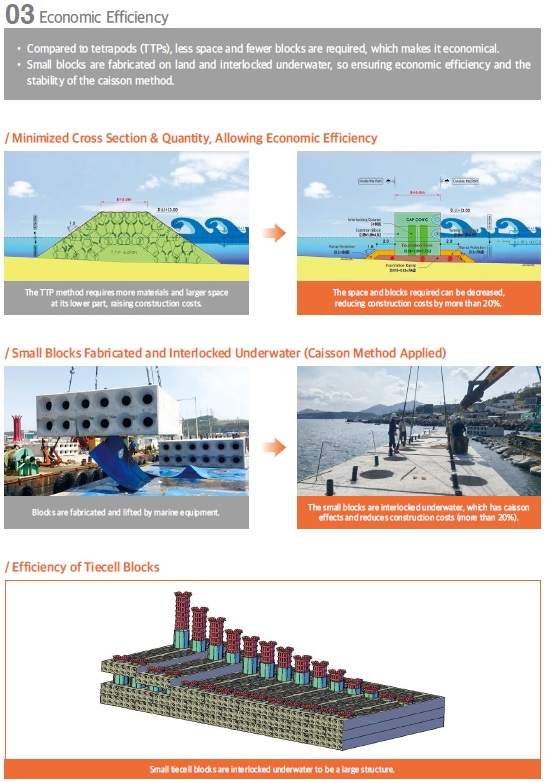
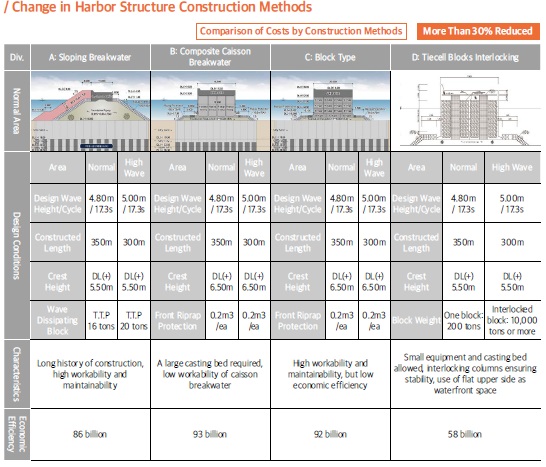
• Compared to tetrapods (TTPs), less space and fewer blocks are required, which makes it economical.
• Small blocks are fabricated on land and interlocked underwater, so ensuring economic efficiency and the stability of the caisson method.
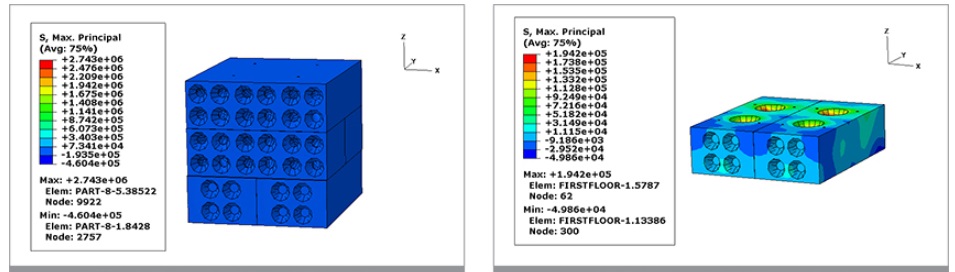
4. Structure Stability
(a) Total Stress Distribution of Tiecell-Turning wave Block system applied Tiecell block method
(b) Distribution on 1st layer Block of Tiecell-Turning wave Block system applied Tiecell block method
(c) Stress Distribution on 2nd layer Block of Tiecell-Turning wave Block system applied Tiecell block method
(d) Stress Distribution on Cap concrete of Tiecell-Turning wave Block system applied Tiecell block method
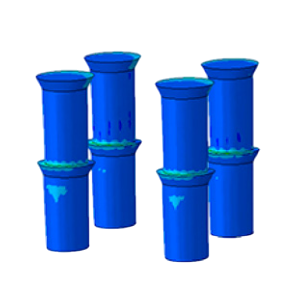
(e) Stress Distribution on pile of Tiecell of Tiecell-Turning wave Block system applied Tiecell block method
Result: Stress Distribution of Tiecell-Turning Wave Block system on 0% for reduction ratio of wave pressure(column of Tiecell)
(a) (b)
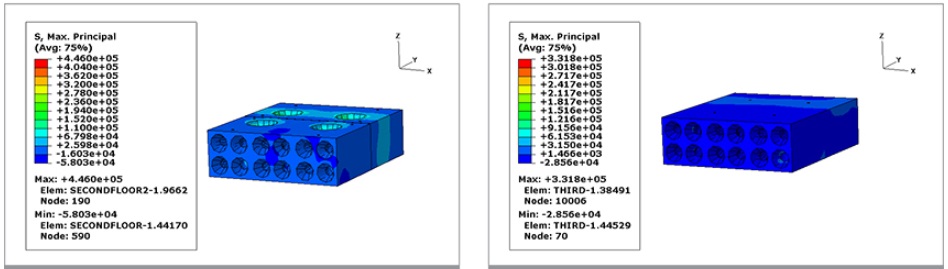
(c) (d)
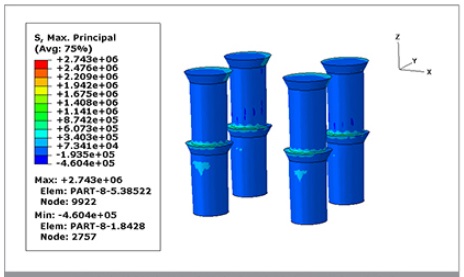
(e)
05 Paradigm Shift
06 Applications
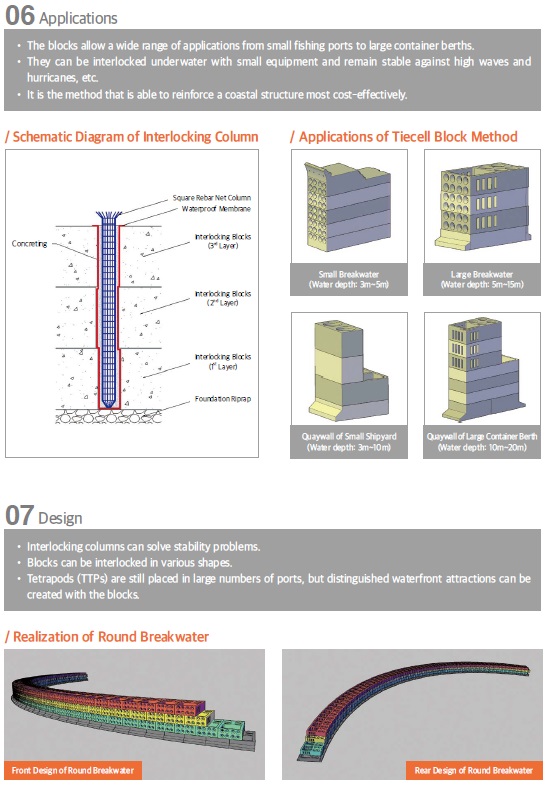
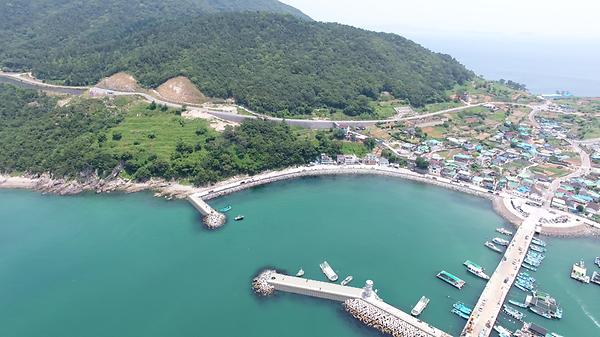
• The blocks allow a wide range of applications from small fishing ports to large container berths.
• They can be interlocked underwater with small equipment and remain stable against high waves and hurricanes, etc.
• It is the method that is able to reinforce a coastal structure most cost-effectively.